
Executive Snapshot
Connect personnel, budget, IT readiness, and position-to-mission alignment in one leadership view.
Explore the DashboardDELIVERY EXAMPLES
These illustrative materials show how a BAVENYX deliverable can support an organizational decision. All data and situations below are fictional demonstrations, not client results or promised outcomes.
Five branded examples. Clear decisions, visible assumptions, and practical next steps.
01 / SYNTHETIC EXAMPLE
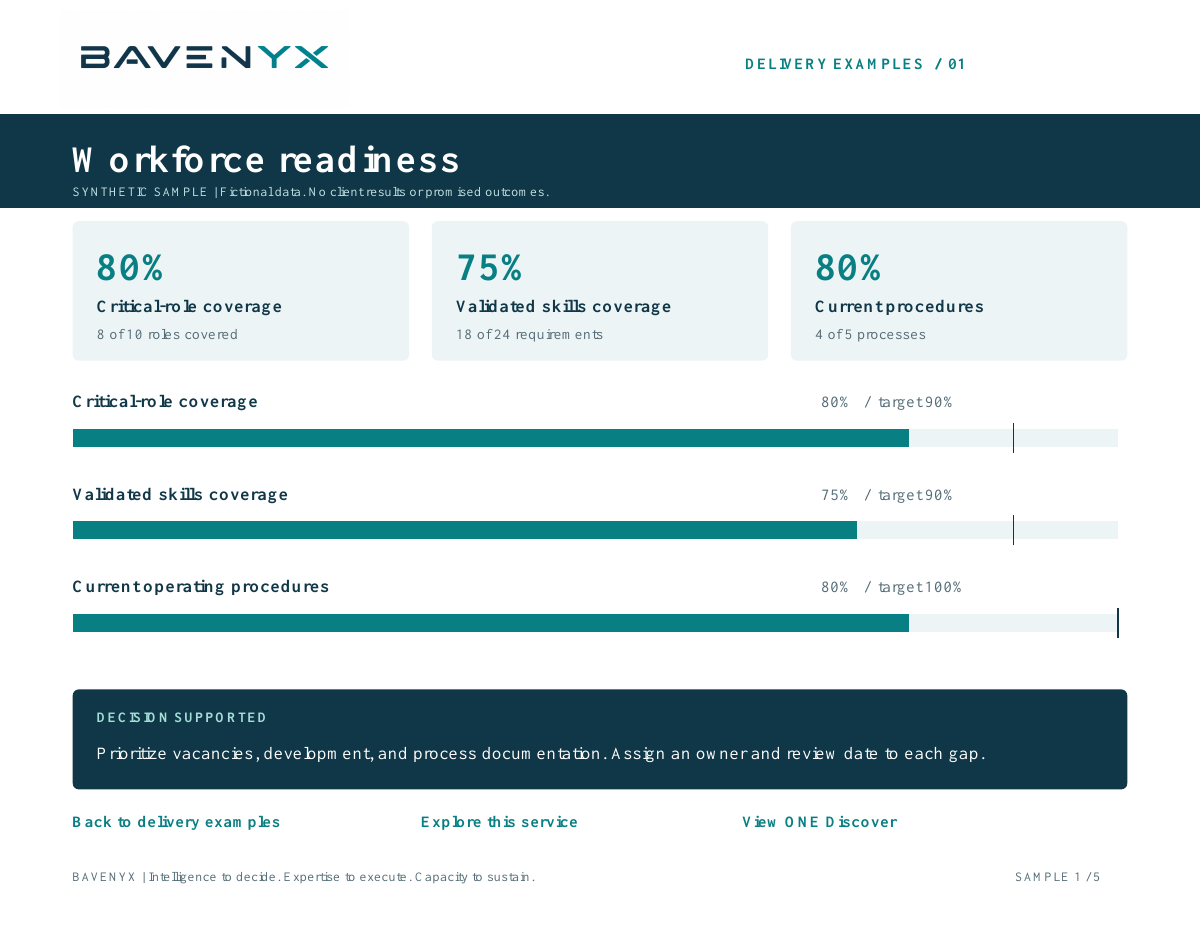
A focused view of role coverage, validated skills, and operating readiness. Each measure supports its own decision; the percentages are not combined into a single score.
| Measure | Illustrative baseline | Example target | Decision supported |
|---|---|---|---|
| Critical-role coverage | 8 of 10 roles · 80% | 90% | Prioritize critical vacancies |
| Validated skills coverage | 18 of 24 requirements · 75% | 90% | Focus development and sourcing |
| Current operating procedures | 4 of 5 processes · 80% | 100% | Assign documentation and review |
A clearer basis for deciding which readiness gaps require action, who owns them, and when progress will be reviewed.
02 / SYNTHETIC EXAMPLE
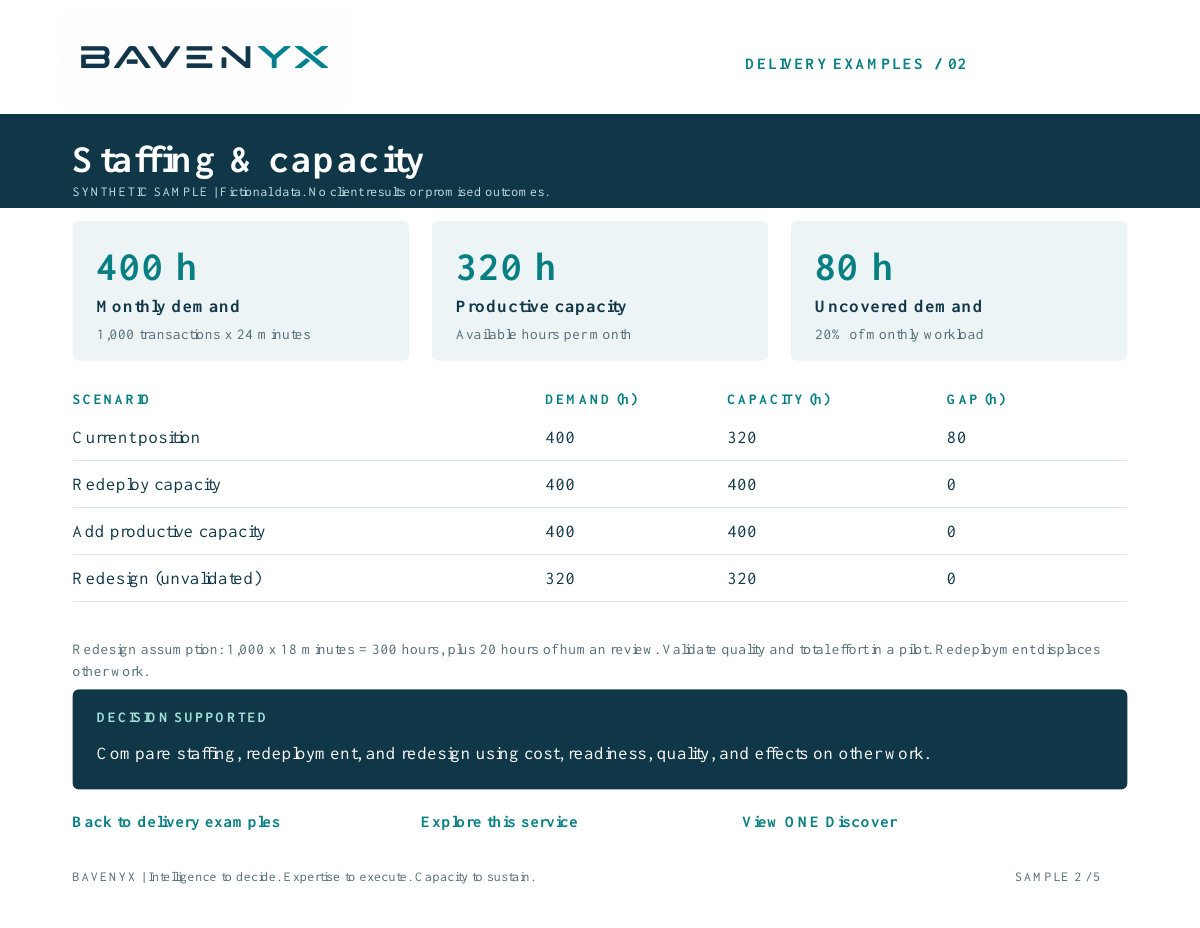
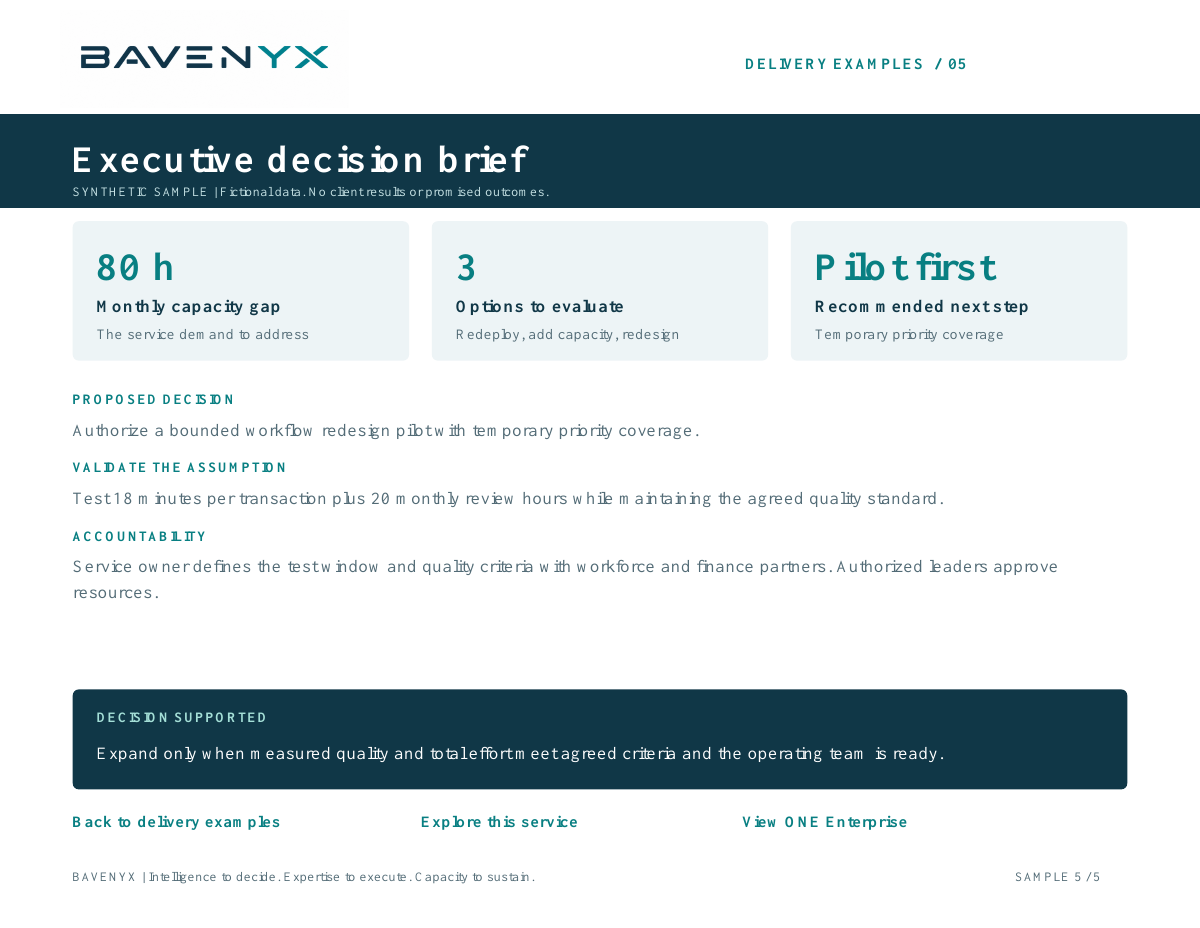
Assume 1,000 transactions per month at 24 minutes each: 400 hours of demand. Available productive capacity is 320 hours, leaving an 80-hour gap.
80-hour gap to address through staffing, redeployment, or validated work redesign.
| Scenario | Monthly demand | Productive capacity | Remaining gap | What to evaluate |
|---|---|---|---|---|
| Current position | 400 hours | 320 hours | 80 hours | Backlog and service impact |
| Redeploy capacity | 400 hours | 400 hours | 0 hours | 80 hours displaced from other work |
| Add productive capacity | 400 hours | 400 hours | 0 hours | Cost, readiness, and time to proficiency |
| Redesign the workflow | 320 hours* | 320 hours | 0 hours* | Pilot quality and total handling effort |
*Illustrative redesign assumption: 1,000 × 18 minutes = 300 hours, plus 20 hours of human review. This scenario requires pilot validation.
A comparison of hiring, redeployment, and redesign that makes capacity assumptions and operational trade-offs explicit.
03 / SYNTHETIC EXAMPLE
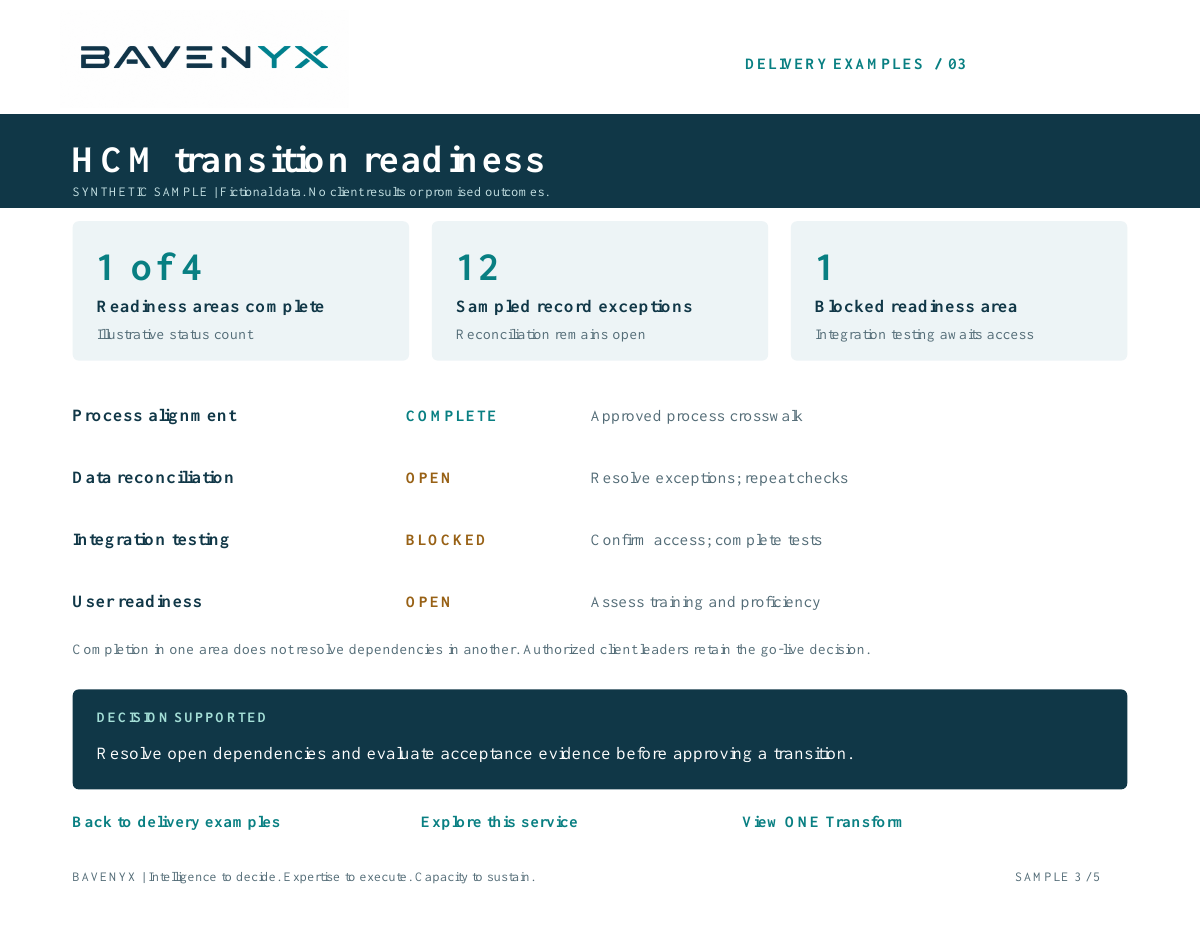
Readiness depends on evidence across processes, data, integrations, and people. A completed activity in one area does not resolve an open dependency in another.
| Readiness area | Status | Evidence or open condition | Next action |
|---|---|---|---|
| Process alignment | Complete | Process crosswalk approved | Maintain the approved baseline |
| Data reconciliation | Open | 12 sampled record exceptions | Resolve exceptions and repeat reconciliation |
| Integration testing | Blocked | Access and remaining tests pending | Confirm access and complete testing |
| User readiness | Open | Training assessment pending | Evaluate proficiency before transition |
A visible set of transition dependencies and acceptance evidence for the client’s authorized go-live decision.
04 / SYNTHETIC EXAMPLE
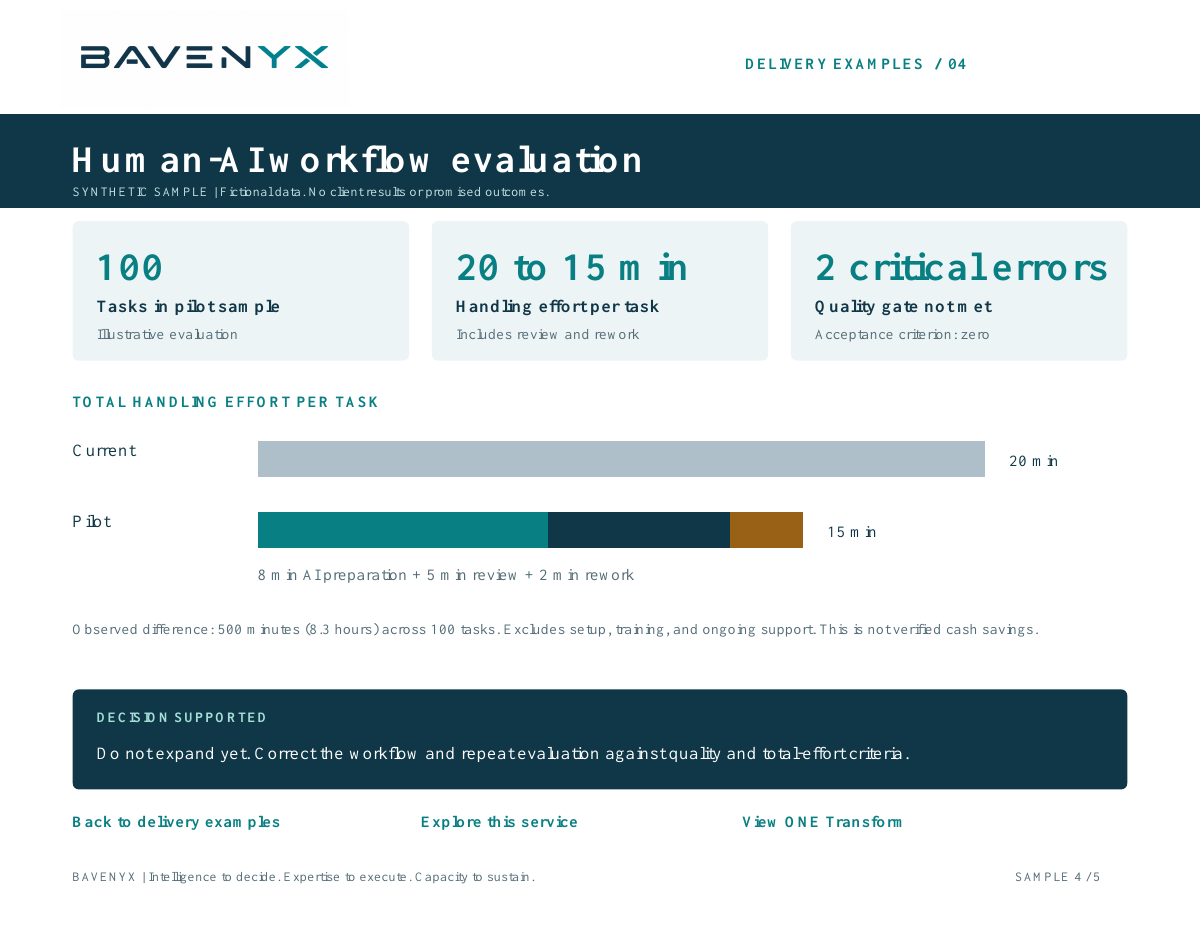
Evaluate the full workflow, including human review and correction, before treating faster output as usable capacity.
| Measure | Illustrative observation |
|---|---|
| Pilot sample | 100 tasks |
| Current handling effort | 20 minutes per task |
| AI preparation and generation | 8 minutes per task |
| Human review | 5 minutes per task |
| Rework | 2 minutes per task |
| Total pilot handling effort | 15 minutes per task |
| Observed effort difference | 500 minutes · 8.3 hours across 100 tasks |
| Critical quality errors | 2 of 100 tasks; example acceptance criterion is 0 |
The sample fails its critical-error criterion. The observed time difference also excludes setup, training, and ongoing support. Correct the workflow and repeat evaluation against the agreed quality and effort criteria.
05 / SYNTHETIC EXAMPLE
An executive decision supported by explicit assumptions, options, accountable owners, and a clear next step.
INTELLIGENCE YOU CAN EXPLORE
Connect personnel, budget, IT readiness, and position-to-mission alignment in one leadership view.
Explore the DashboardShare seven service briefs, compare four package scope cards, and explore before-and-after workflow concepts.
Browse the CollectionPeople. Resources. Technology. Mission. Read our first edition on connecting information to leadership action.
Read the NewsletterLET’S TALK ABOUT THE WORK
Start with a defined need or bring several priorities together. We’ll shape the services and delivery around the work your organization needs to accomplish.